

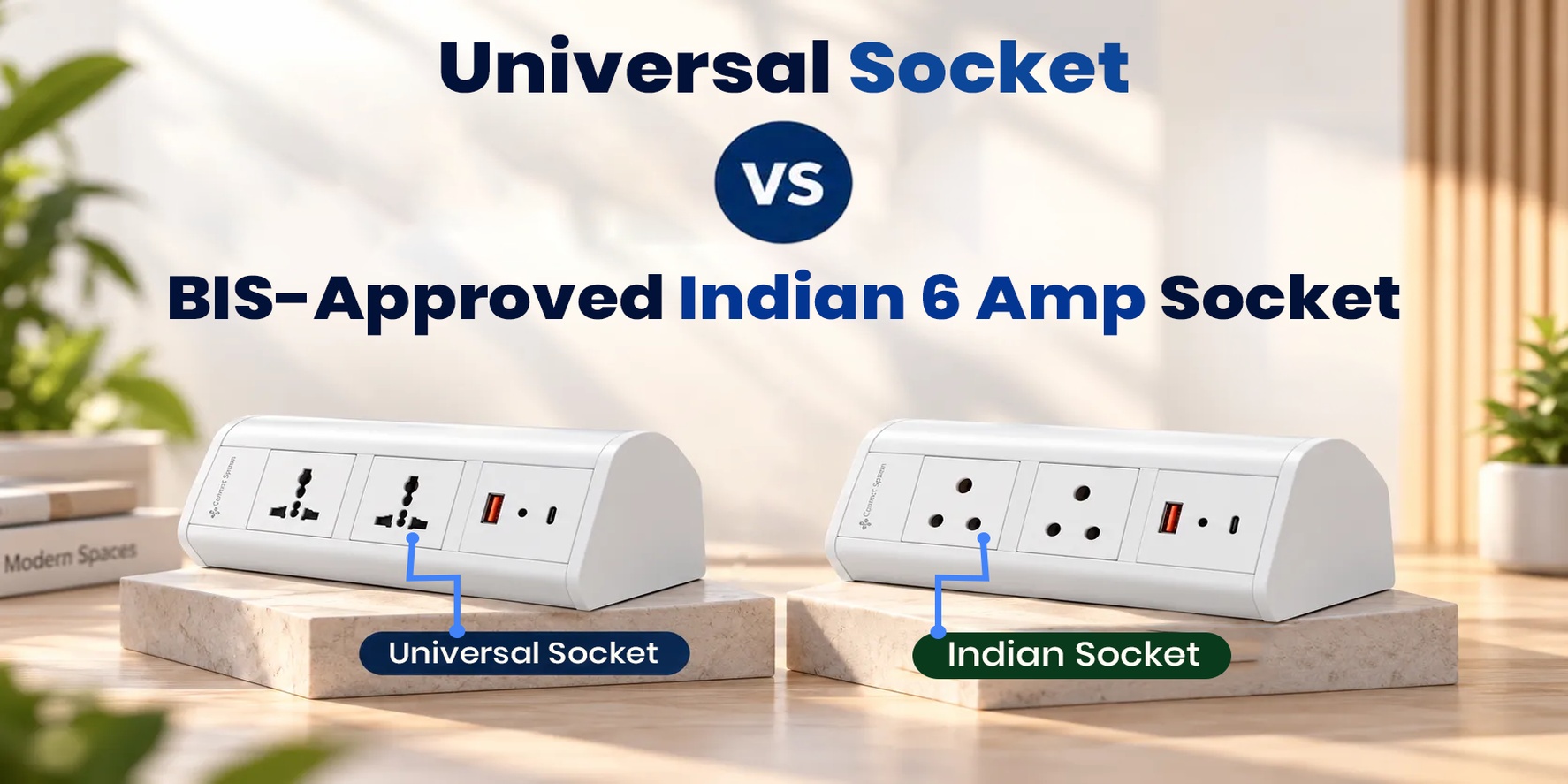
Universal Socket vs BIS-Approved Indian 6 Amp Socket is an important comparison when choosing electrical sockets for offices, meeting rooms and modern workspaces. At Connect System, we believe a workspace is only as safe as the socket behind the desk. Offices, meeting rooms and workstations plug in laptops, monitors, chargers and conferencing equipment all day, every day. Yet the socket itself is rarely questioned.
So when you are specifying sockets for an office or workspace, which is the safer choice: a multi-standard universal socket, or a BIS-approved Indian 6 Amp socket? Here is a clear, practical comparison.
What Is a Universal Socket?
A universal socket is built to accept many plug types (Indian, US, UK, European and others) in one faceplate. It looks convenient, especially in spaces with international visitors or imported devices.
The problem is the design itself. A socket that must fit many different pin shapes and sizes cannot be optimised for any one of them.
What Is a BIS-Approved Indian 6 Amp Socket?
In India, plugs and socket-outlets for household and similar purposes are covered by IS 1293, the Indian Standard issued by the Bureau of Indian Standards (BIS). The current version, IS 1293:2019, is based on the international standard IEC 60884-1 and covers accessories up to 16A and 250V. Its scope includes 6/16A sockets.
When we talk about Universal Socket vs BIS-Approved Indian 6 Amp Socket, we need to understand in simple terms, that a BIS-approved 6A socket is designed, tested and licensed to work with the Indian plug it is meant for, and to meet defined requirements for construction, contact quality, temperature rise and protection against shock.
Plugs and sockets in this category require BIS certification for import, trade and use in India, which is why the ISI mark and licence number matter.

Universal Socket vs BIS-Approved Indian 6 Amp Socket- Why Universal Sockets Raise Safety Concerns
Safety bodies and standards organisations in several countries have warned against universal socket-outlets. The common concerns are:
Poor contact and loose fit. Sockets should make full contact with the plug pins and hold the plug firmly. Oversized openings and generic contacts often do neither, which can lead to arcing, overheating and, in the worst case, fire.
Missing or ineffective safety shutters. Some universal sockets have no shutters at all, and others use shutters that can be opened by pushing an object into a single hole.
Exposed live pins. When a plug that is not designed for that socket is inserted, its pins can remain accessible while it is connected.
Earthing and polarity problems. Not every plug type can be earthed or polarised correctly in a one-size-fits-all contact layout.
Cannot meet a single-plug standard. Because they accept many plug types, they generally cannot be certified against the standard written for one specific plug and socket system.
These concerns come from international safety bodies and testing organisations, not from any one manufacturer. They apply to the design concept, which is why the safest option for a permanent installation is a socket made for the plug that will actually be used.
Why Nickel-Plated Contacts Matter when we talk about Universal Socket vs BIS 6 Amp Socket
The contact is where electricity actually passes from the socket to the plug. If that connection is weak, resistance rises, and resistance produces heat.
Nickel-plated contacts help because they:
- Resist oxidation and corrosion, so contact quality holds up over years of use.
- Help keep contact resistance low and stable.
- Stay reliable through repeated plugging and unplugging.
A reliable electrical connection is not a luxury feature. In a busy office socket carrying a continuous load, it is one of the main defences against overheating.
Note: Nickel plating is a quality feature offered by good manufacturers, not a separate legal requirement. It works alongside, not instead of, BIS certification.
Protection Against Electric Shock
A safe socket keeps live parts out of reach, both when it is empty and when a plug is partly inserted. That is the job of properly designed shutters, correct pin-hole geometry and quality insulating material.
This is where purpose-built sockets have a clear advantage. Their openings, shutters and contacts are designed around one plug system, so protection does not have to be compromised to fit other plug shapes.
Universal Socket vs BIS-Approved Indian 6 Amp Socket: Key Differences
| Factor | Universal Socket | BIS-Approved Indian 6A Socket |
|---|---|---|
| Design | Accepts many plug types | Designed for the Indian plug system |
| Contact fit | Generic contacts, risk of loose fit | Contacts made for the intended pins |
| Shock protection | Shutters often missing or less effective | Built around defined protection requirements |
| Heat and overheating risk | Higher where contact is poor | Lower, with temperature rise tested to the standard |
| Standard | Not certifiable against a single-plug standard | Tested to IS 1293 |
| Verifiable certification | Usually none | ISI mark and CML number you can check |
| Best for | Occasional travel use | Permanent office and workspace installation |
The verdict: For permanent installation in offices and workspaces, a BIS-approved socket made for the Indian plug is the safer choice.
BIS Certification Requirements for Sockets in India
A genuine BIS-certified socket should carry:
- The ISI mark.
- A valid CML (Certification Marks Licence) number.
- The manufacturer’s name.
- Product rating and specifications.
However, a mark printed on the product is not proof by itself. A common malpractice is printing a genuine licence number on a product it was never issued for, such as a switch licence appearing on a socket. That is why verification matters.
How to Verify BIS Certification
BIS CARE is the Government of India’s free mobile app for checking certification claims.
Download:
Android: https://play.google.com/store/apps/details?id=com.bis.bisapp
iPhone/iPad: https://apps.apple.com/in/app/bis-care-app/id6443724891
Steps:
- Find the ISI mark and the CML number printed on the product or its packaging.
- Open the BIS CARE app and complete the one-time OTP identity verification.
- Select Verify Licence Details.
- Enter the CML number.
- Check the result carefully.
Do not stop at “the licence exists.” Confirm that:
- The manufacturer name matches the product.
- The brand matches the packaging.
- The licence is active.
- The product category in the BIS record is actually plug and socket-outlet.
If the app returns no details for the number, treat the product as suspect. You can also report misuse of the ISI mark through the same app.
Always verify using the official app or BIS portal directly, never through a link or QR code supplied by the seller.
Quick Checklist Before You Buy Sockets for Your Office
Before purchasing electrical sockets for your office, use this checklist:
- ISI mark clearly present.
- CML number present and verified on BIS CARE.
- Licence category matches sockets, not switches or plugs.
- Manufacturer in BIS records matches the brand you are buying.
- Contacts built for secure, tight plug retention.
- Shock protection built into the socket.
- Supplier can share certification details on request.
- Price is in line with the market (very low prices are a warning sign).
Simple Rule for Safe Socket Selection
- No ISI Mark.
- No Verified CML Number.
- No Matching Product Category.
- No Purchase.
Choose Verified, BIS-Compliant Electrical Solutions
Connect System – Smart Electrical for Modern Workspaces. We focus on reliable electrical solutions for offices, meeting rooms and workstations, built around safety and BIS compliance.
The comparison between a universal socket and a BIS-approved Indian 6 Amp socket highlights the importance of choosing suitable electrical accessories for the intended application. Before purchasing, verify the applicable certification, product specifications and compatibility with your electrical requirements.
Explore our range at https://connectsystem.in/ or write to us at Customer Care (care@connectsystem.in).
Keywords: universal socket safety in india, Universal Socket vs BIS-Approved Indian 6 Amp Socket, Universal Socket Safety, BIS Certification, Electrical Socket Safety, Office Electrical Solutions, Indian Socket, electrical safety, types of electrical sockets in india, Connect system, BIS certification